How arts therapy can support trauma healing.
Trauma can change the way we experience ourselves and the world around us.
It isn't merely what happened to us. Trauma can occur when an experience overwhelms our ability to cope, leaving us feeling unsafe, disconnected, powerless or unable to make sense of what happened. Sometimes the effects are obvious: intrusive memories, anxiety, nightmares or hypervigilance. At other times, trauma manifests more quietly: difficulty trusting others, feeling disconnected from your body, becoming easily overwhelmed, or unexpected floods of emotion.
Remembering more, or talking about it more, isn't always the way to heal from trauma. In fact, trying to relive those moments can sometimes retraumatise us. Sometimes, healing begins instead by finding a gentler way to approach what happened.
approaching difficult experiences
When we've experienced something overwhelming, it makes sense that we might not want to confront it head-on. We might avoid certain memories, push difficult feelings away, stay busy, disconnect from our bodies, or tell ourselves we're doing just fine. These responses can be ways we've subconsciously adopted to protect ourselves. How often have you felt a sensation, or acted in a way you knew in your head was irrational or disproportionate to the situation, but felt powerless to respond any other way?
Trauma can affect our sensory, emotional and bodily responses alongside our memories and beliefs, which is part of why it can feel so difficult to recall a traumatic experience as a coherent story (van der Kolk & van der Hart, 1991). Because so much of what trauma disrupts sits outside language in the first place, therapies that rely on words alone don't always reach it. Foundational work on arts therapy and the brain proposed that art-making draws on different levels of processing- from bodily, sensory experience through to symbolic, cognitive meaning-making, offering a route into material that talk-based approaches can struggle to access (Lusebrink, 2004).
Creative approaches offer another way in. Where trauma has dishevelled our emotional landscape, the order of events or the factual truth isn't always what matters most. So rather than beginning with "tell me what happened," arts therapy can start somewhere much gentler, meeting you where you are, in the moment.
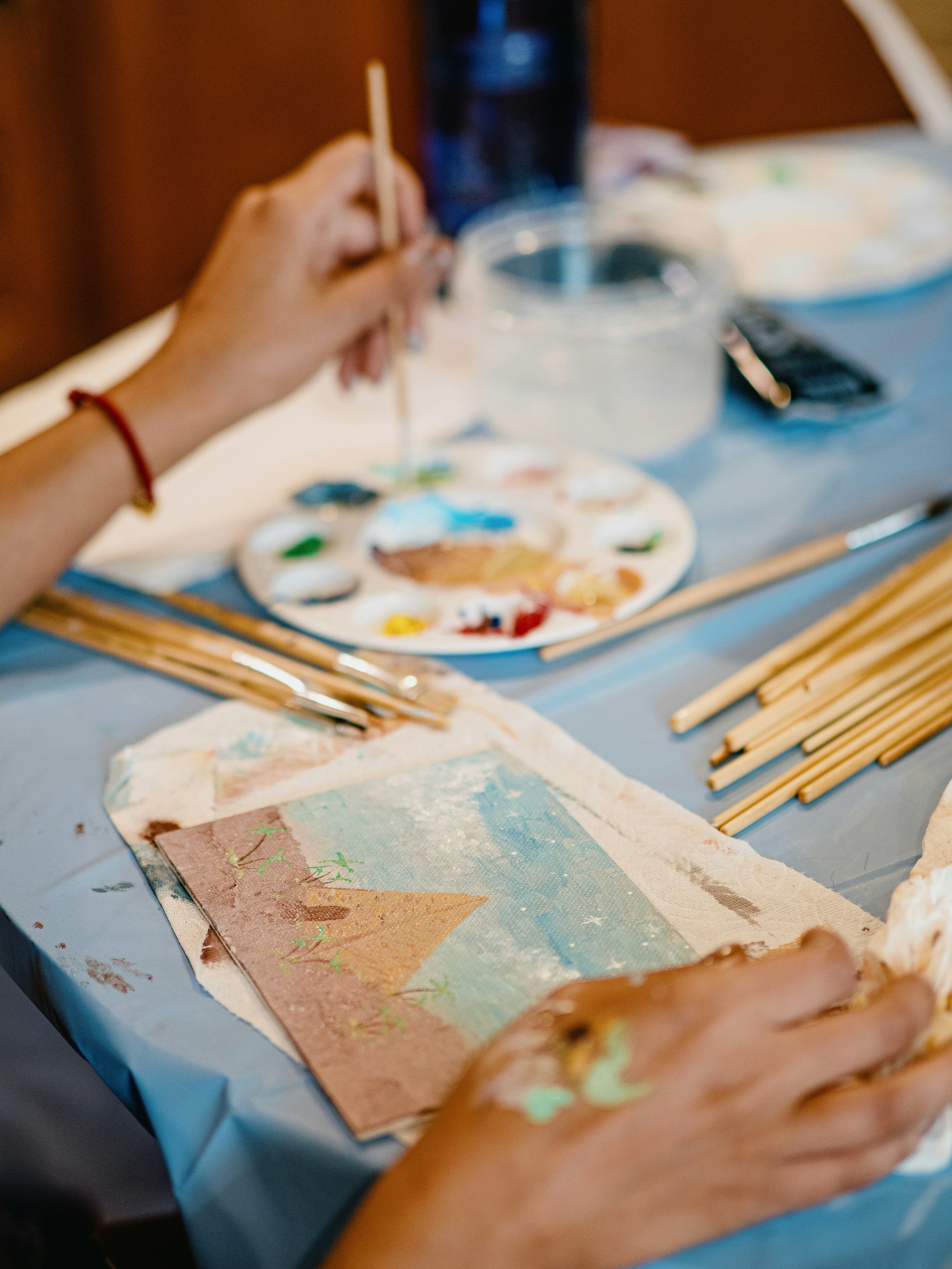
In session, you might choose a colour, make a mark, punch some clay, or tear up some paper. Arts therapists help you explore and hold whatever needs to be expressed, safely. We support you in the creative process to draw meaning from your art-making and your artwork in ways that aren't prescriptive, but true to you.
openness to play
Playfulness has an important place in the process of arts therapy and healing.
Trauma can make life feel very serious. We may become vigilant, controlling, cautious, or focused on avoiding what might go wrong. Play, by contrast, gives us permission to experiment without worrying about the outcome.
When we play, we can try something and change our mind. We can make a mess. We can make something strange or silly and start again. In arts therapy sessions, you can take risks and strengthen your emotional capacities within a safe, forgiving space. Over time, this can build your capacity to take those same risks and navigate difficult emotions beyond the therapy room, in everyday life.
Research supports the importance of playfulness to wellbeing. Farley, Kennedy-Behr and Brown (2021) found that playfulness in Australian adults was positively associated with positive emotion, engagement, relationships, meaning and overall wellbeing. Research by Clifford and colleagues (2022) similarly found links between adult playfulness, stress and coping during the COVID-19 pandemic, suggesting playfulness can shape the way we respond to challenging experiences more broadly, not only in the moment they occur.
Playfulness creates room for curiosity, flexibility and possibility- qualities that are especially valuable when trauma has left us feeling stuck, guarded or disconnected. Ironically, it's in the seriousness of our trauma that playfulness is needed the most.
creativity gives an experience somewhere to go
One of the powerful things about making art is that an internal experience can become external.
A feeling that's been difficult to understand can take form. A memory can become an image. Anger might become an energetic mark made with charcoal. Grief might become fragments carefully arranged on a page.
You don't necessarily need to cognitively understand or explain an experience before you can begin exploring it. This is what I found most relieving when I embarked on this path myself. You might not even know what you're creating and then suddenly it makes sense.
The artwork can hold some of what feels difficult to hold inside. This idea is reflected in research into the mechanisms of art therapy. Czamanski-Cohen and Weihs (2016) proposed the bodymind model, describing how art therapy engages interconnected processes involving the body, emotions, cognition, creativity and the therapeutic relationship. A 2026 review of the neuroscience behind creative arts therapies describes this same process as externalisation, turning an internal, often pre-verbal experience into something concrete and separate from the self, which creates a kind of psychological distance that makes intense emotion easier to approach and work with (Vaisvaser et al., 2026).
Creating engages multiple aspects of experience at once. The artwork becomes more than something you make. It becomes a container for experience, somewhere feelings, memories, sensations and questions can exist outside of you, where they can be observed, revisited, shifted and explored. Sometimes we don't realise what, or how much, we've been carrying until we see it sitting in front of us.
holding & making space for what comes next
Importantly, trauma doesn't have to be represented literally.
You don't need to paint the event that happened to you. Creative expression can be abstract, symbolic, or seemingly unrelated on the surface. What matters is the personal meaning that develops through the process. You can look at something difficult without being completely inside it. You can change it, cover it, tear it apart, add something new, or simply decide you're finished for today.
Research continues to build a case for this kind of creative engagement. An early systematic review by Schouten and colleagues (2015) found evidence that art therapy can reduce trauma-related symptoms in adults who have experienced psychological trauma. A more recent 2024 systematic review and meta-analysis of 21 randomised controlled trials (868 participants total) found that arts therapy following trauma showed a clear, statistically significant benefit for wellbeing outcomes such as quality of life, alongside a promising (though not yet definitive) trend toward reducing PTSD-specific symptoms (Maddox et al., 2024). A 2025 meta-analysis focused specifically on children and adolescents found a large, statistically significant reduction in PTSD symptoms across 33 studies (Applewhite et al., 2025), with especially strong effects in populations where creative, nonverbal expression is already woven into cultural life. Taken together, the evidence for creative approaches to trauma has grown substantially in just the past few years.
Perhaps most importantly, creative work doesn't ask us to erase what happened. Instead, it gives us a way to hold it. The experience can become part of the story, without having to remain the whole story.
There's no single right way to heal. Sometimes we need words. Sometimes we need movement. Sometimes we need another person to sit beside us. And sometimes we need our hands to make something before we can understand what's happening inside us.
Arts therapy offers a space for all of this. Not because art magically makes trauma disappear, but because creativity can give difficult experiences somewhere to land and give us the freedom to approach them with curiosity, gentleness and, sometimes, play.
You don't have to know exactly what you're carrying before you begin. Sometimes the process of creating helps you discover what needs to be held.
References
Applewhite, B., Delattre, B., Singh, I., Kringelbach, M., & Spiegler, O. (2025). Creative arts-based interventions for the
improvement of PTSD symptoms in young people: A meta-analysis with a focus on non-Western populations. Nature Mental Health, 3, 1616–1632. https://doi.org/10.1038/s44220-025-00543-y
Clifford, C., Paulk, E., Lin, Q., Cadwallader, J., Lubbers, K., & Frazier, L. D. (2022). Relationships among adult playfulness, stress, and coping during the COVID-19 pandemic. Current Psychology, 43(9), 8403–8412. https://doi.org/10.1007/s12144-022-02870-0
Czamanski-Cohen, J., & Weihs, K. L. (2016). The bodymind model: A platform for studying the mechanisms of change induced by art therapy. The Arts in Psychotherapy, 51, 63–71. https://doi.org/10.1016/j.aip.2016.08.006
Farley, A., Kennedy-Behr, A., & Brown, T. (2021). An investigation into the relationship between playfulness and well-being in Australian adults: An exploratory study. OTJR: Occupational Therapy Journal of Research, 41(1), 56–64. https://doi.org/10.1177/1539449220945311
Lusebrink, V. B. (2004). Art therapy and the brain: An attempt to understand the underlying processes of art expression in therapy. Art Therapy: Journal of the American Art Therapy Association, 21(3), 125–135.
Maddox, G. A., Bodner, G. E., Christian, M. W., & Williamson, P. (2024). On the effectiveness of visual arts therapy for traumatic experiences: A systematic review and meta-analysis. Clinical Psychology & Psychotherapy, 31, e3041. https://doi.org/10.1002/cpp.3041
Schouten, K. A., de Niet, G. J., Knipscheer, J. W., Kleber, R. J., & Hutschemaekers, G. J. M. (2015). The effectiveness of art therapy in the treatment of traumatized adults: A systematic review on art therapy and trauma. Trauma, Violence, & Abuse, 16(2), 220–228. https://doi.org/10.1177/1524838014555032
Vaisvaser, S., Shalem-Zafari, Y., Ram-Vlasov, N., & Shamri-Zeevi, L. (2026). Neuroscience-informed creative group therapy for processing trauma and developing resilience during wartime. Journal of Personalized Medicine, 16(3), 128. https://doi.org/10.3390/jpm16030128
van der Kolk, B. A., & van der Hart, O. (1991). The intrusive past: The flexibility of memory and the engraving of trauma. American Imago, 48(4), 425–454.
Curious about Arts Therapy?
If you're wondering whether Arts Therapy might be right for you, I offer a complimentary discovery call where we can discuss your needs, and whether my approach feels like a good fit.